
Neurodivergent Child Friendly Tours in Washington DC
Families With Neurodivergent Children Face Many Challenges When Choosing Activities in Washington DC.
Here’s a Solution to Some of the Most Common Problems Families Face
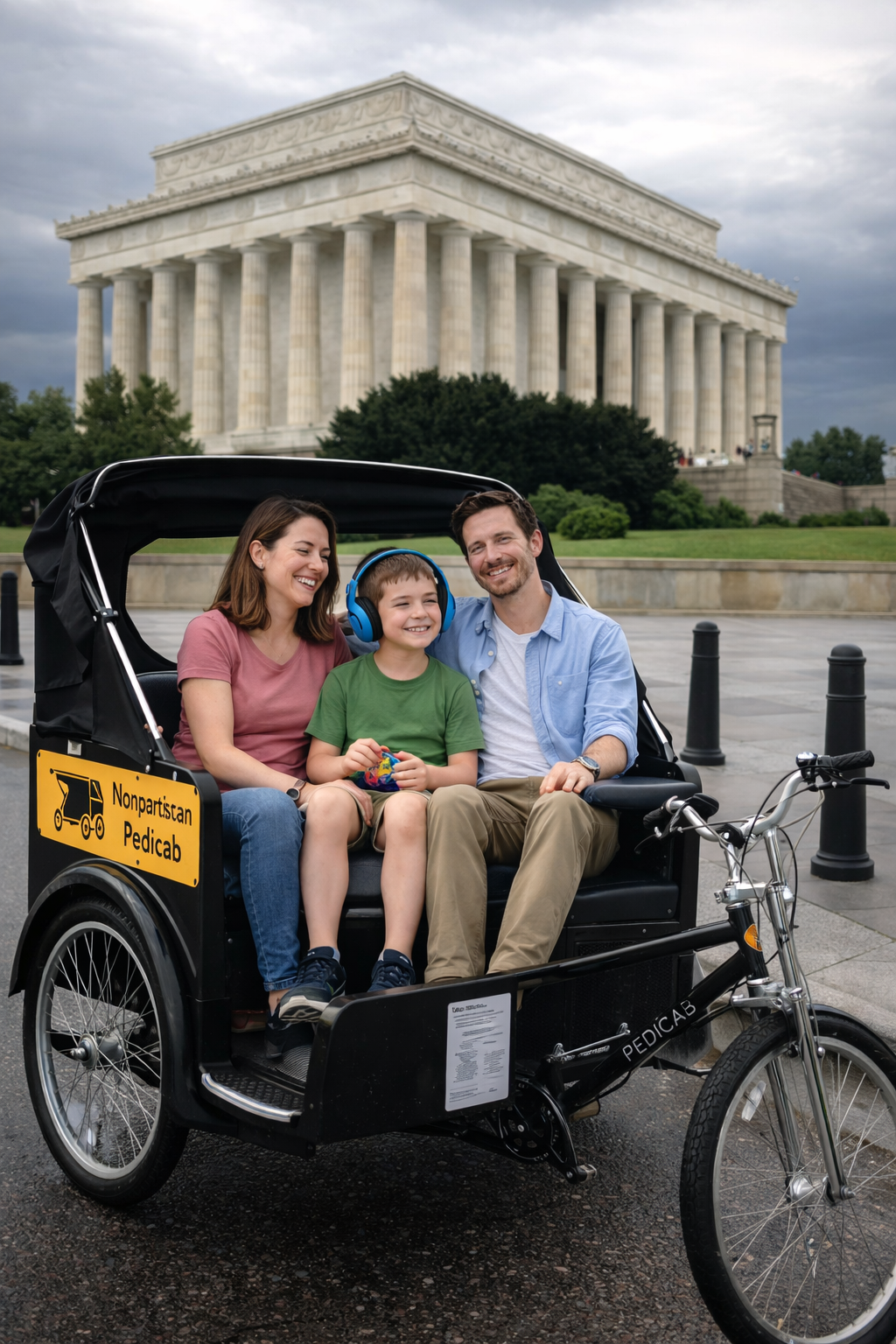
Finding activities in Washington DC that genuinely work for neurodivergent children can be exhausting. Parents often ask the same questions: How do we avoid sensory overload? How do we stay flexible if plans change? How can we see the city without meltdowns, long walks, crowds, or rigid schedules? A private pedicab tour from Nonpartisan Pedicab directly addresses these challenges by offering a calm, customizable, low-stress way to experience the National Mall and monuments—without the common triggers that make traditional sightseeing overwhelming.
Below is a practical, experience-based listicle outlining the specific problems families with neurodivergent children encounter—and how a Nonpartisan Pedicab tour provides real solutions.
1. Problem: Overstimulating Environments Trigger Sensory Overload
Solution: A Controlled, Open-Air, Low-Stimulus Experience
Many parents search for sensory-friendly activities in Washington DC because museums, crowded sidewalks, loud tour groups, and enclosed spaces can quickly overwhelm neurodivergent children. Pedicab tours remove many of these stressors.
A pedicab ride offers:
-
Open-air seating rather than enclosed vehicles
-
No amplified audio systems or headphones
-
A slower pace with fewer unpredictable stimuli
-
Reduced crowd exposure compared to walking tours
The ability to regulate speed, stop when needed, and maintain physical space helps children who are sensitive to noise, crowds, or visual overload remain calm and engaged.
2. Problem: Long Walking Distances Lead to Fatigue and Meltdowns
Solution: Effortless Transportation Between Key Sites
Parents frequently ask, “How do we see the monuments without exhausting our child?” The National Mall spans over two miles, and walking it can be physically and emotionally draining.
Nonpartisan Pedicab eliminates this barrier by:
-
Transporting families directly between monuments
-
Allowing children to rest while still participating
-
Preventing fatigue-related sensory dysregulation
Children can observe, ask questions, or disengage quietly when needed—without the pressure to “keep going.”
3. Problem: Rigid Schedules Don’t Work for Neurodivergent Kids
Solution: Fully Flexible, Parent-Led Pacing
Many traditional tours follow strict itineraries that do not accommodate emotional regulation needs. A common search phrase among parents is “flexible activities for autistic children in DC.”
Pedicab tours are inherently adaptable:
-
Stops can be shortened or skipped
-
Breaks can be taken without disrupting a group
-
Routes can be adjusted in real time
This flexibility gives caregivers control, reducing anxiety for both parent and child.
4. Problem: Group Tours Create Social Pressure and Anxiety
Solution: Private, Family-Only Tours
Social demands can be overwhelming for children with autism, ADHD, or sensory processing differences. Large tour groups introduce unpredictable behaviors, noise, and expectations.
A Nonpartisan Pedicab tour is private:
-
No strangers sharing the experience
-
No pressure to interact or perform socially
-
No judgment if a child needs quiet time or space
This privacy creates psychological safety, which is often the foundation for positive experiences outside the home.
5. Problem: Children Lose Interest When Content Isn’t Accessible
Solution: Narrative-Based, Child-Responsive Storytelling
Parents often search for “educational but engaging activities for neurodivergent children.” Traditional tours can overwhelm with dates and dense historical facts.
Pedicab guides adapt explanations by:
-
Using storytelling rather than lectures
-
Responding to children’s questions naturally
-
Adjusting detail level based on engagement
Children can listen actively, passively, or not at all—without disrupting the experience.
6. Problem: Sudden Transitions Cause Emotional Dysregulation
Solution: Gradual Movement and Predictable Transitions
Fast transitions—boarding buses, entering buildings, rushing to schedules—are common triggers. Pedicabs offer smooth, visible transitions.
Children can:
-
See where they are going next
-
Anticipate stops visually
-
Remain seated during transitions
This predictability reduces anxiety associated with change and uncertainty.
7. Problem: Parents Feel Judged in Public Spaces
Solution: A Compassionate, Low-Pressure Environment
Many caregivers ask, “Where can we go without worrying about stares or comments?” Public spaces can feel hostile when a child behaves outside social norms.
Pedicab tours minimize exposure to:
-
Crowded interiors
-
Long stationary waits
-
Close-quarters scrutiny
The guide’s focus remains on the family—not public expectations.
8. Problem: Safety Concerns Limit Exploration
Solution: Secure Seating and Controlled Routes
Parents of neurodivergent children often prioritize safe activities with minimal risk of wandering. Pedicabs provide:
-
Secure seating
-
Continuous adult supervision
-
Clearly defined movement paths
This allows families to explore more confidently without constant vigilance fatigue.
9. Problem: Parents Need Activities That Work for Mixed-Needs Families
Solution: Inclusive Experiences for Neurotypical and Neurodivergent Siblings
Families often ask, “What activities work for all our kids?” Pedicab tours balance stimulation and calm, making them accessible across a wide range of needs.
Older siblings can:
-
Engage with history
-
Ask deeper questions
-
Enjoy sightseeing
Meanwhile, neurodivergent children can participate on their own terms.
10. Problem: Unpredictable Time Commitments Create Stress
Solution: Clear Duration With Built-In Exit Options
Parents frequently search for short, manageable activities in DC. Pedicab tours:
-
Have defined timeframes
-
Allow early conclusion without penalty
-
Avoid long entry lines or waiting periods
Knowing there is an “easy exit” reduces anticipatory anxiety.
11. Problem: Weather Can Derail Carefully Planned Days
Solution: Adaptable Outdoor Touring With Shade and Stops
Unlike long outdoor walks, pedicab tours allow:
-
Shade breaks
-
Short shelter stops
-
Reduced physical exposure to heat or cold
This adaptability is critical for children whose regulation is impacted by temperature or discomfort.
12. Problem: Parents Want Meaningful Experiences, Not Just Survival
Solution: Calm, Positive Memory-Building
Many caregivers ask, “How can we actually enjoy DC with our neurodivergent child?” A successful pedicab tour shifts the goal from endurance to enjoyment.
Families leave with:
-
Shared memories
-
Reduced emotional exhaustion
-
A sense of accomplishment rather than relief
This emotional outcome is often more valuable than the sightseeing itself.
13. Problem: Difficulty Finding Trustworthy, Inclusive Providers
Solution: Nonpartisan Pedicab’s Family-Centered Approach
Parents actively search for inclusive tour providers in Washington DC. Nonpartisan Pedicab emphasizes:
-
Respectful, nonpolitical storytelling
-
Personalized pacing
-
Family-first experiences
14. Problem: Too Many “Sensory-Friendly” Activities Still Miss the Mark
Solution: Real-World Flexibility, Not Just Labels
Many attractions label themselves sensory-friendly but remain rigid in practice. Pedicab tours are sensory-adaptive by design, not marketing.
They respond to:
-
Real-time needs
-
Emotional cues
-
Family preferences
This responsiveness is what parents are truly seeking.
15. Problem: Planning Fatigue Before the Trip Even Starts
Solution: One Activity That Covers Multiple Needs
Parents often search “best low-stress things to do with autistic children in DC.” A pedicab tour consolidates:
-
Transportation
-
Education
-
Sightseeing
-
Downtime
Fewer moving parts mean less planning stress.
Final Thoughts: A Practical, Compassionate Solution for Real Families
For families navigating Washington DC with neurodivergent children, the goal is not perfection—it is predictability, flexibility, and dignity. A pedicab tour from Nonpartisan Pedicab directly addresses the most common barriers parents face while offering a calm, engaging, and respectful way to experience the city.
Rather than forcing children to adapt to the activity, the activity adapts to the child. That distinction makes all the difference.
More Resources
If you are interested in further exploring accessible travel resources for neurodivergent families, Neuordivergent Navigators is an organization that can help you find practical guides, tips, and support to make every adventure more enjoyable.
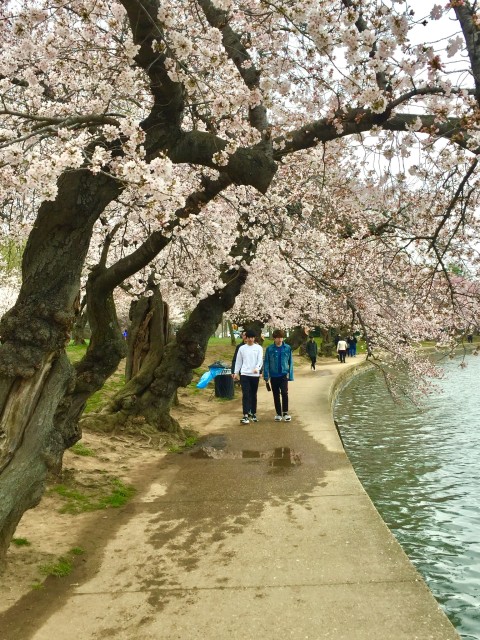
The cherry blossoms come into bloom in late March and early April every year. A tour of the cherry blossoms is very popular.